



Home

/
Tranche 2 Reforms
/
Tranche 2 Compilance: What you need to know

The Clock is Ticking: Australia's Tranche 2 AML/CTF Reforms

Newly regulated Australian businesses in professional services must prepare now for mandatory Anti-Money Laundering and Counter-Terrorism Financing obligations.
Obligations Commence:
192
Days
:
86
Hours
:
35
Minutes
:
25
Seconds
192
Days
:
86
Hours
35
Minutes
:
25
Seconds
Compliance Deadline: 1st July 2026

What is Tranche 2 and What Are the Obligations?

Tranche 2 refers to the expansion of Australia’s Anti-Money Laundering and Counter-Terrorism Financing (AML/CTF) Act to cover Designated Non-Financial Businesses and Professions (DNFBPs). These sectors were previously exempt but are now recognised globally as high-risk for exploitation by criminals.
The reforms aim to align Australia with global standards set by the Financial Action Task Force (FATF). This means bringing industries like legal services, accountancy, and real estate under the regulatory oversight of AUSTRAC.

The Core Mandate

The goal is to ensure approximately 90,000 newly regulated entities implement robust controls to detect, deter, and disrupt financial crime, protecting the integrity of Australia's financial system.

Key Obligations

  • Enrolment with AUSTRAC.
  • Develop a risk-based AML/CTF Program.
  • Conduct Customer Due Diligence (CDD).
  • Appoint an AML Compliance Officer.
  • Report Suspicious Matters (SMRs).
  • Maintain records for seven years.

Are You a Tranche 2 Entity? (Mandated Industries)

The reforms expand the AML/CTF regime to Designated Non-Financial Businesses and Professions (DNFBPs). If you offer "designated services" in these sectors, you are now regulated.

Legal Services

Solicitors, Lawyers, and Conveyancers involved in transactions like property transfers, managing client funds, or establishing legal entities (Trusts/Companies).

Accounting & TCSPs

Accountants and Bookkeepers who handle client funds, provide corporate secretarial services, or set up and manage Trust and Company Service Providers (TCSPs).

Real Estate

Real Estate Agents involved in the buying, selling, or auctioning of property. This sector is considered high-risk for money laundering.

Real Estate

Real Estate Agents involved in the buying, selling, or auctioning of property. This sector is considered high-risk for money laundering.

Precious Metals & Stones

Dealers in high-value goods like bullion, precious metals, and stones, particularly in transactions of $10,000 or more.

Precious Metals & Stones

Dealers in high-value goods like bullion, precious metals, and stones, particularly in transactions of $10,000 or more.

Mandatory AUSTRAC Enrolment

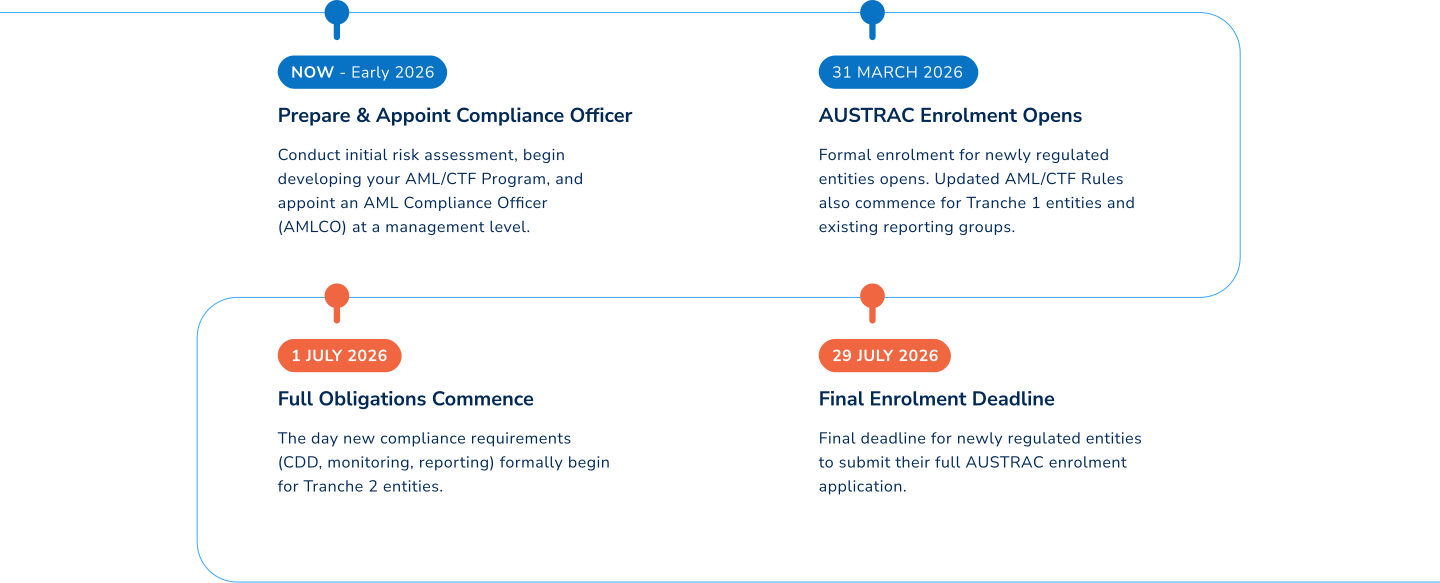
All newly regulated entities must enrol with AUSTRAC (Australia’s financial intelligence agency) to receive ongoing guidance and meet regulatory requirements. Enrolment opens 31 March 2026.

Mandatory AUSTRAC Enrolment

All newly regulated entities must enrol with AUSTRAC (Australia’s financial intelligence agency) to receive ongoing guidance and meet regulatory requirements. Enrolment opens 31 March 2026.
Are You Tranche 2 Ready? Take Our Compliance Quiz.
In just 5 minutes, assess your current compliance readiness, identify your key gaps, and get a personalised action plan to meet the July 2026 deadline.
Instant results | No sign-up required

Deeper Dive: Core Compliance Obligations

We offer automated Risk Management compliance solutions to help businesses effortlessly meet Tranche 2 obligations.
Develop a Tailored AML/CTF Program
You must conduct a thorough ML/TF Risk Assessment based on your services, customers, and delivery channels. This assessment forms the foundation for your written AML/CTF Program, which must be regularly reviewed and maintained.
Rigorous Customer Due Diligence (CDD)
This involves Verifying Client Identities (Know Your Customer/KYC), understanding the Beneficial Owners of entities, and conducting Ongoing Monitoring of transactions to ensure they align with the customer's risk profile. Enhanced checks are required for high-risk customers, like Politically Exposed Persons (PEPs).
Reporting and Record Keeping
You must report Suspicious Matters (SMRs) to AUSTRAC when you have reasonable grounds to suspect illegal activity. You must also keep comprehensive records of all CDD processes and transactions for a minimum of seven years to facilitate regulatory oversight.
Compliance Intelligence (Powered by Gemini API)
Use our AI-powered tools to instantly clarify complex compliance jargon and generate industry-specific ML/TF risk scenarios for staff training and risk assessments.
Jargon Buster: Get Instant Definitions
Ask for a concise explanation of any AML/CTF term (e.g., 'SMR', 'LPP', 'VASP').
Thank you! Your submission has been received!
Oops! Something went wrong while submitting the form.
Risk Scenario Generator
Generate a high-risk scenario relevant to your industry and operational area for risk assessment training.
Thank you! Your submission has been received!
Oops! Something went wrong while submitting the form.

How MemberCheck Ensures Compliance and Efficiency

For financial institutions, superannuation, real estate, and professional services, manual compliance is no longer sustainable. MemberCheck provides an automated, enterprise-grade RegTech solution to meet every Tranche 2 obligation seamlessly.
Automated Due Diligence
Instant global screening for PEP (Politically Exposed Persons), Sanctions, and Adverse Media, drastically reducing onboarding time and risk.
Real-Time Monitoring
Continuous, real-time tracking of customer risk profiles. Receive instant alerts on changes to maintain Ongoing CDD and compliance.
Identity & Business Checks
Simplified, powerful KYC and Know Your Business (KYB) checks, including beneficial ownership and identity verification.
Audit-Ready Records
Secure, encrypted storage of all compliance data for seven years, guaranteeing an audit-ready trail for AUSTRAC inspections.
Key Milestones: Planning Your Transition
October 2025
Finalisation of Core Guidance 
October to November 2025
Targeted consultation on Tranche 2 sector-specific guidance in working groups with industry associations and peak bodies
December 2025
Finalisation of Tranche 2 sector-specific guidance
August to December 2026
Ongoing enhancements to the sector-specific guidance for current reporting entities in partnership with industry 
1 July 2026
AML/CTF obligations commence for Tranche 2 entities  
31 March 2026
FinalisatiChanges to obligations for current reporting entities and virtual assets service providers on of Core Guidance 

What Happens If You Do Not Comply?

AUSTRAC is rigorously enforcing AML/CTF laws. Failure to comply can result in severe legal, financial, and reputational damage.
Massive Fines
Maximum Civil Penalty per
contravention:
Up to
$33 Million
(For Corporations)
Criminal Consequences
For individuals and officers involved in intentional or reckless breaches (e.g., 'Tipping Off'):
Up to 2 Years Imprisonment
(Plus additional fines)
Reputational Ruin
Loss of client trust, mandatory public announcements, and increased regulatory scrutiny.
Client & Investor Exodus
(Irreparable damage)

Ready to Future-Proof Your Compliance? Speak to Our AML Experts.

Discover how our enterprise AML solutions can simplify your Tranche 2 obligations and keep your business compliant and secure.

Trusted by 1000+ Industry Leaders

Achmea logoB4Finance LogoHealix LogoTitan LogoThe Cooperavtive Bank LogoFexco LogoEML LogoCSC LogoSatori LogoHumm Logo

Dates to Remember

The reforms will go into effect on March 31, 2026, including the replacement of Part 7 of the AML/CTF Act with a more outcomes-oriented approach to risk alleviation and management for reporting entities.

New Customer Due Diligence (CDD) criteria will be implemented, as well as increased coverage of the AML/CTF regime for high-risk service providers such as real estate agents and virtual asset service providers. Key revisions include new legislation on tipping-off violations and electronic financial transfer reporting, which modernise the framework to meet global standards.

Finally, by July 1, 2026, more clarifications will be provided respecting legal professional privilege in reporting obligations and the treatment of bearer negotiable instruments. A transitional time is allowed for new reporting entities, allowing them to prepare for compliance with the enhanced AML/CTF regulations before the deadlines.

Stay Ahead of Tranche 2 – Get Started Today!

Don’t wait for enforcement to begin - ensure compliance now. Book a consultation or explore our AML/CTF solutions to safeguard your business.

Contact Us

Proven Compilance Results

75%

Reduction in false positives

24 hrs

Watchlists updated daily

40%

Average reduction in onboarding time

< 1 sec

Average response time

1000+

PEP & Sanctions Watchlists
*Statistics based on average user experience across several industries

Tranche 2 Resources

Transaction Monitoring

Tranche 2 AML Compliance: Impact on Trust and Company Service Providers (TCSPs)

BLOG

Australia is increasing its defences against financial crime by making major changes to its Anti-Money Laundering and Counter-Terrorism...

Read More
Transaction Monitoring

Tranche 2 AML Compliance: Impact on Precious Metals and Stone Dealers

BLOG

As part of a broader effort to align with international standards set by the Financial Action Task Force (FATF), the AML/CTF regime will now...

Read More
Transaction Monitoring

Tranche 2 AML Compliance: Impact on the Accounting Profession

BLOG

The Tranche 2 Reforms aim to strengthen Australia’s ability to combat financial crime. A crucial part of these reforms is the...

Read More
Transaction Monitoring

Tranche 2 AML Compliance: Impact on Real Estate Professionals

BLOG

The Tranche 2 Reforms aim to strengthen Australia’s ability to combat financial crime. A crucial part of these reforms is the introdu...

Read More
Transaction Monitoring

Tranche 2 AML Compliance: Impact on Lawyers

BLOG

Australia is increasing its defences against financial crime by making major changes to its Anti-Money Laundering and Counter-Terrorism Financi...

Read More
Transaction Monitoring

Guide to Tranche 2 Reforms

REPORT

Australia's new AML/CTF laws are expected to result in major regulatory changes. These amendments aim to close current gaps by...

Download Now

Enhancing and Strengthening Australia's AML/CTF Regime

Australia is committed to safeguarding the integrity of its financial system and countering the threats posed by money laundering and terrorism financing. To ensure a robust and responsive Anti-Money Laundering and Counter-Terrorism Financing (AML/CTF) regime, the Australian Government has initiated a public consultation on the proposed reforms.

These reforms aim to simplify and modernise the regime's operations. They extend coverage to high-risk professions, including lawyers, accountants, trust and company service providers, real estate agents, and dealers in precious metals and stones - collectively referred to as Tranche 2 entities.

What Is Tranche 2?

Tranche 2 is the next phase of Australia’s AML/CTF regulations, designed to strengthen financial crime prevention by expanding compliance requirements to non-financial sectors that handle high-value transactions.
Who will be affected?
Lawyers
Accountants
Real Estate Agents
Precious Metals and Stone Dealers
Trust and Company Service Providers (TCSPs)
What are the new obligations?
  • Enrol with AUSTRAC
  • Develop an AML/CTF program
  • Conduct Customer Due Diligence (CDD)
  • Perform ongoing CDD
  • Report suspicious activity
  • Maintain record-keeping

Conclusion

The proposed reforms to Australia's AML/CTF regime aim to simplify and modernise its operation while extending its coverage to Tranche 2 entities. By streamlining obligations and including high-risk professions, the Australian Government seeks to strengthen its efforts in combating money laundering and terrorism financing. The consultation process provides an opportunity for industry stakeholders to contribute their expertise and shape the development of a robust AML/CTF framework that aligns with international standards and best practices. Together, government and industry can work towards a safer and more resilient financial system that protects the integrity of Australia's economy and communities.